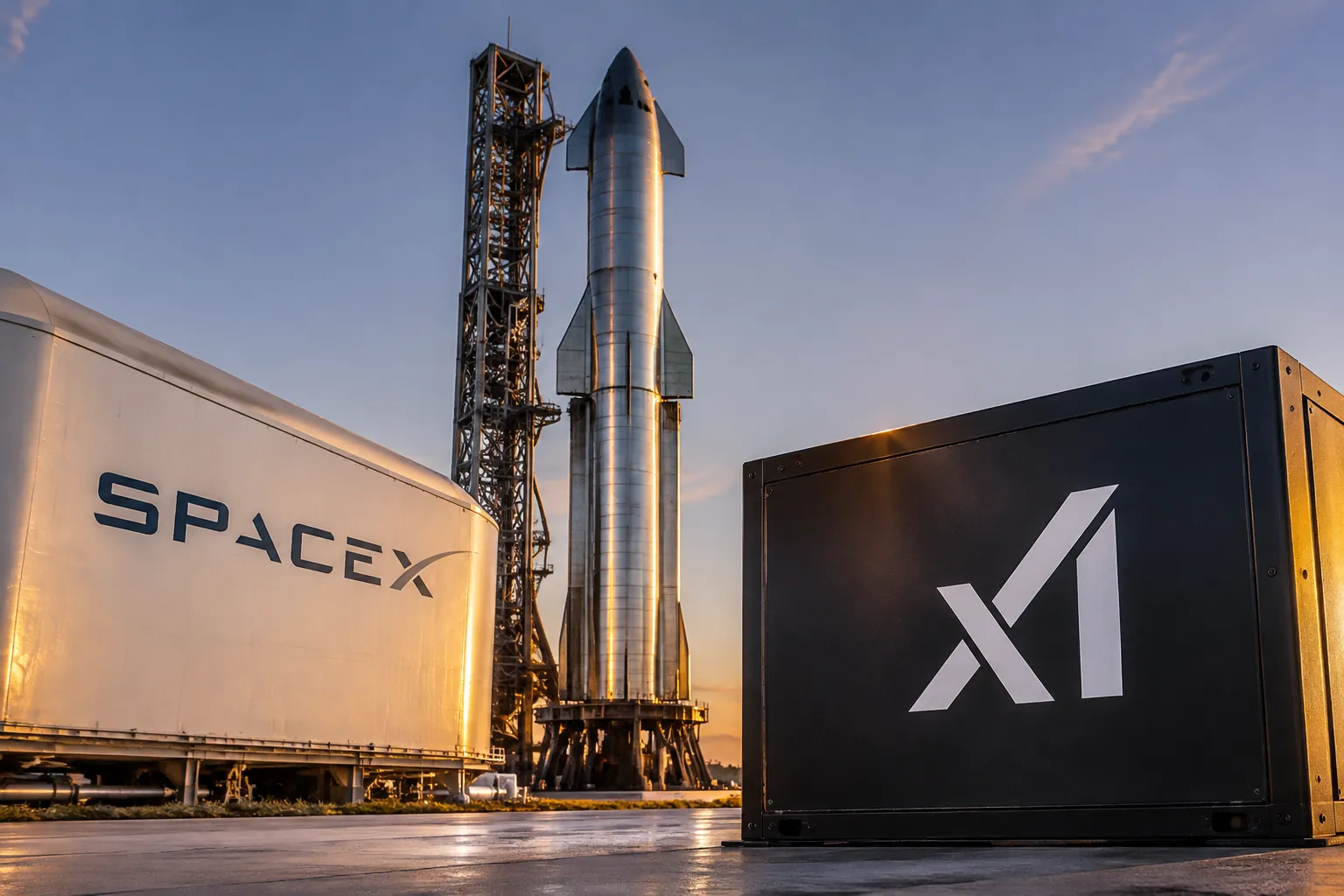
SpaceX acquires xAI
SpaceX has acquired xAI and says it will use Starship to launch orbital data centers, a bet that space will become the cheapest place to run AI compute within three years.
SpaceX has announced that it has acquired xAI. The post, signed "Elon," describes the combined company as a "vertically-integrated innovation engine" covering AI, rockets, Starlink internet, direct-to-mobile communications and what it calls "the world's foremost real-time information and free speech platform."
The announcement gives no deal terms. It does not include a price, a valuation, a structure, a closing date or any detail on how xAI will be run inside SpaceX.
Most of the post makes the case for space-based AI compute. It argues that terrestrial data centers cannot meet AI's electricity demand "without imposing hardship on communities and the environment," and proposes a constellation of up to a million satellites working as solar-powered orbital data centers.
The post sets out its own figures:
- Launch cadence: Starship flights every hour, each carrying 200 tons, delivering millions of tons to orbit per year.
- Compute per ton: at 100 kW of compute per ton, launching one million tons a year would add 100 GW of AI compute capacity annually. The post says there is "a path" to 1 TW per year.
- Cost: the author estimates that "within 2 to 3 years, the lowest cost way to generate AI compute will be in space."
- Context: about 3,000 tons of payload reached orbit in 2025, the busiest launch year on record.
The post also says Starship will begin launching V3 Starlink satellites this year, with each launch adding more than 20 times the capacity of a current Falcon V2 launch. Over the longer term, it describes lunar factories and an electromagnetic mass driver that could place 500–1,000 TW per year of AI satellites into deep space.
None of these projections have been independently verified, and the post gives no timeline for the first orbital compute deployment.