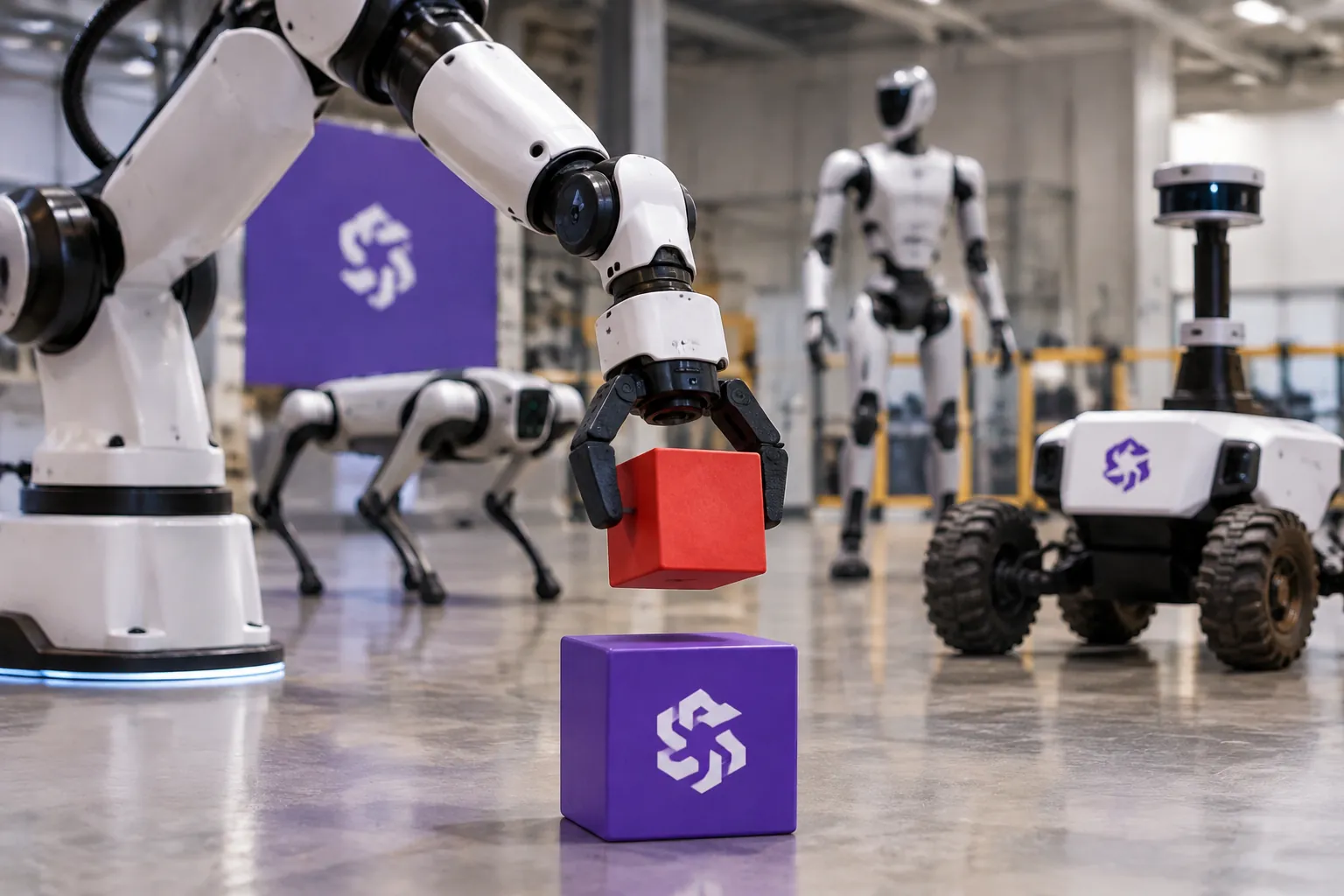
Qwen releases RobotWorld embodied world model
Qwen's RobotWorld world model uses natural language as a shared action interface, so manipulation, driving and navigation can be trained together across more than 20 robot embodiments.
Qwen has introduced Qwen-RobotWorld, a world model for embodied agents. It aims to fix a split in the field: general video generators learn strong visual priors but don't model embodied physics, while domain-specific models built for one setup don't carry over to other robots.
Qwen's answer is to use natural language as the action space. An instruction such as "pick up the red cup and place it on the shelf" stands in for robot-specific control signals. According to the team, this puts 20+ robot embodiments and 500+ action categories behind one interface. Manipulation, autonomous driving and indoor navigation are trained jointly on 8.6 million video-text pairs.
The model is a dual-stream Multimodal Diffusion Transformer (MMDiT). One stream encodes the language action with a frozen Qwen2.5-VL. The other processes visual latents from a video VAE, and the two streams share joint attention at every layer. Qwen says an MLLM encoder handles compositional instructions better than T5 or CLIP. It also says the encoder's world knowledge reduces failures such as objects deforming from one frame to the next.
The model can generate 2–4 synchronized camera views with consistent object identity, with no change to the architecture. A component called Scene2Robot retargets human demonstrations to 14 robot morphologies. Qwen uses it both to scale training data and for human-to-robot transfer at inference.
The training data, called the Embodied World Knowledge dataset, includes about 5.9M manipulation samples, about 200K driving samples and 6K+ navigation episodes. Sources include Bridge V2, Droid, Agibot-World, Waymo and an internal Qwen-Aloha set.
RobotWorld is one of three models in a new Qwen-Robot Suite, Qwen said. Qwen-RobotManip handles manipulation. Per a separate post, it pairs a Qwen3.5-4B backbone with a flow-matching DiT action head and maps all embodiments to one 80-dimensional state-action vector, using camera-frame delta poses. Its corpus of more than 38,100 hours of open-source data combines ~11,420h of robot data, ~1,933h of human video and ~24,808h synthesized from it across 15 embodiments. It ranked first on RoboChallenge Table30 v1 (45% SR) and scored 91.4% on LIBERO-Plus. Qwen-RobotNav, built on Qwen3-VL and trained on 15.6M samples, covers five navigation task families with one set of weights.
Qwen reports RobotNav scores of 76.5% SR on VLN-CE RxR, 75.6% on HM3Dv2 ObjectNav, 90.0% on EVT-Bench, 91.4 PDMS on NAVSIM and new bests on three EQA benchmarks, at sizes from 2B to 8B. With Qwen3.7-Plus as planner, it scored +15.4% on EXPRESS-Bench using 77% fewer steps than the prior best. It also ran zero-shot on a Unitree Go2 quadruped on NVIDIA Jetson Thor, at 196 ms latency.
The material reviewed does not include benchmark results for RobotWorld or say whether the weights or code will be released.
Sources
Updates
- Added RobotManip architecture, training-corpus breakdown and benchmark results
- Added Qwen-Robot Suite context with RobotManip and RobotNav details and RobotNav benchmark results