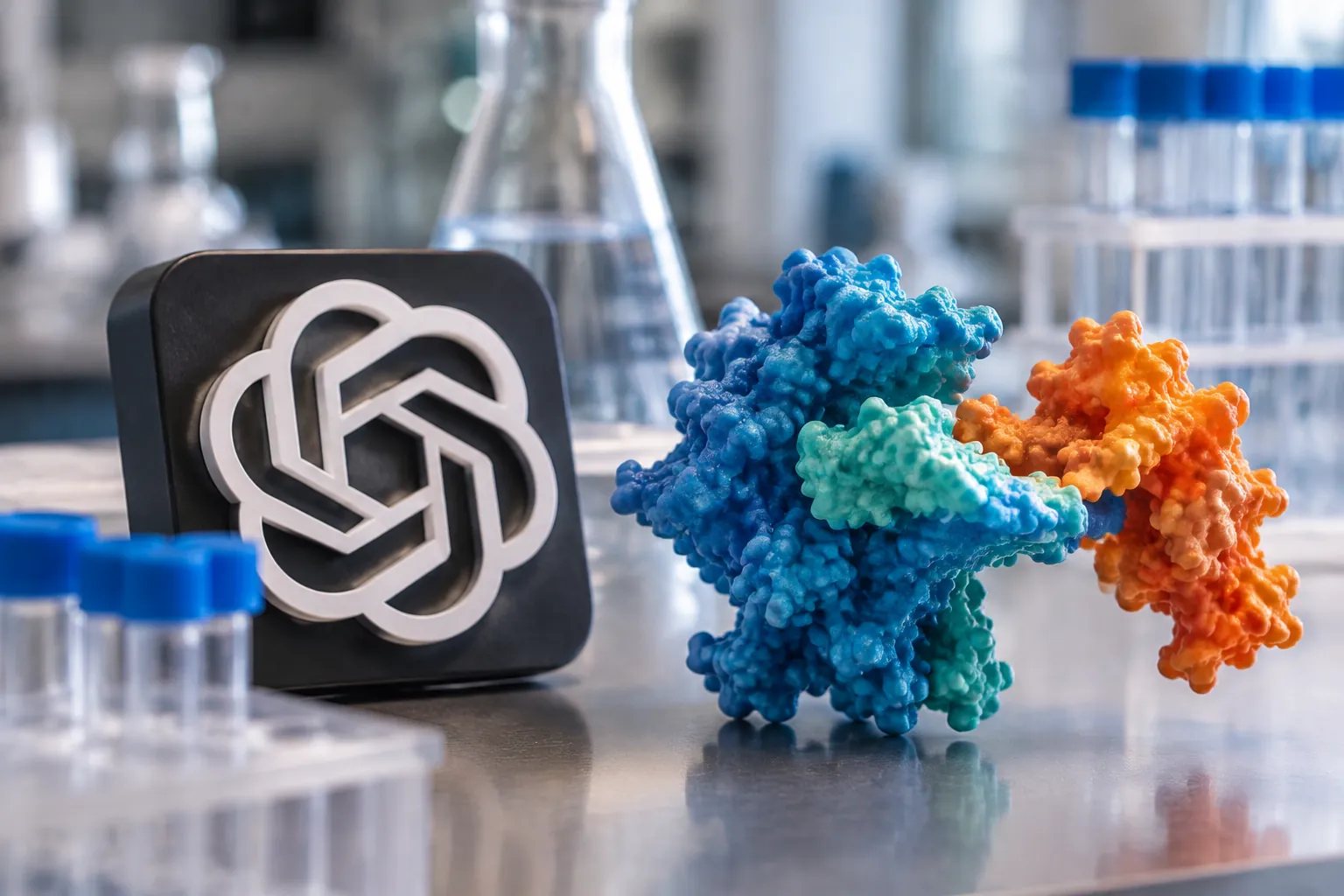
OpenAI says GPT-6 can design proteins
OpenAI says its GPT-6 models can design new protein structures and sequences using only reasoning and code, without specialized biology models, and some designs bound their targets in lab tests.
OpenAI reported in a preprint that its GPT-6 family can design protein structures and amino acid sequences using reasoning and general-purpose coding tools. The models did not call specialized protein AI models to generate the designs.
In computational tests, OpenAI says its latest models matched or beat specialized models on most tasks. These tasks included designing small binding proteins (minibinders), building proteins around specified structural features, predicting molecular interactions, and ranking how sequence changes affect stability and binding. The company said predicting a complete protein's structure "remained a clear weakness." On one design-quality measure, GPT-6.2's 3D designs scored slightly below RFdiffusion, a specialized design model, while unreleased internal models scored higher.
OpenAI says researchers could steer designs through prompts alone. They could specify where a minibinder should attach to its target and how many coils or strands it should have, without retraining. According to OpenAI, an internal model followed these structural instructions with near-perfect accuracy.
Research partner Onava made proteins in the lab from 3D structures designed by a pre-release version of GPT-6.2. For each of the five targets, at least one protein showed evidence of binding. In separate experiments, GPT-6.2 rewrote the sequences of existing minibinders and antibodies, and many of the redesigned proteins still bound their original targets. Specialized models were still part of the lab work, though: they supplied sequences for the GPT-6.2 structures and helped pick which candidates to test.
The source material does not give binding strengths or overall success rates.