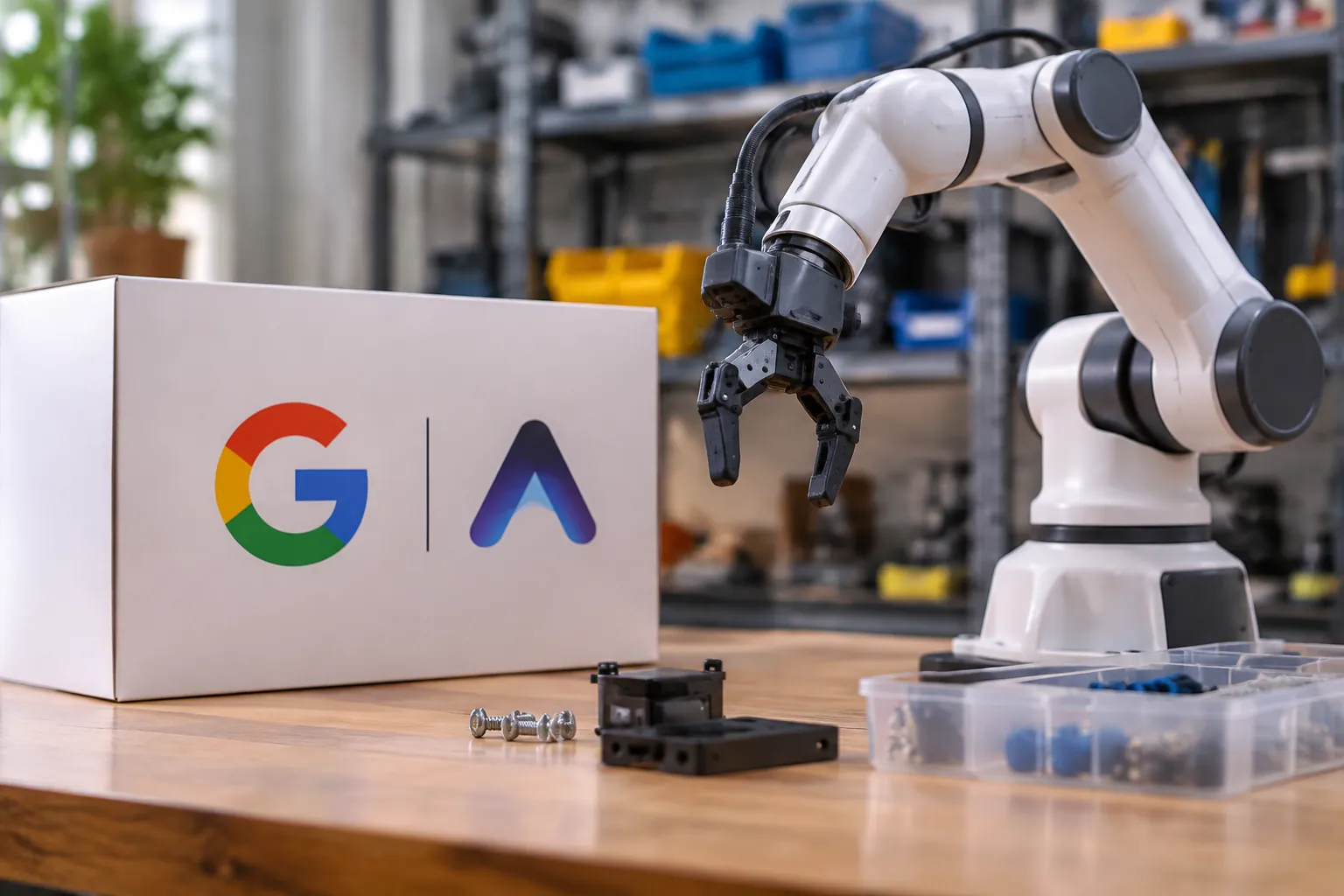
Google adds Robotics plugin to Antigravity
Google has released a Robotics plugin for its Antigravity coding environment that pairs Gemini 4 Hydrogen with skills for hardware setup, simulation and robot control, aiming to make arm deployment an afternoon's work.
Google announced the Robotics plugin for Google Antigravity a week after it launched Gemini 4 Hydrogen, its faster model for spatial and embodied reasoning. The company says the plugin turns Antigravity into a "one-stop robotics workbench." Developers can install it from the Build With Google shelf under Customizations. Antigravity requires a paid Google AI Pro or Ultra subscription.
The plugin bundles skills for hardware onboarding, calibration, simulation and control. In Google's demo, a developer connects an I2RT YAM arm and a depth camera to a laptop. The skills then install the software, find the camera, calibrate the arm and run test motions, and Google says the arm is ready for tasks in about 10 minutes. Google says similar flows bring up the low-cost SO-ARM101 and the industrial FR3 Duo. MuJoCo runs inside Antigravity, so developers can build simulated scenes from text, links or photos and adjust them through chat before deploying to hardware.
In one example, Hydrogen built a MuJoCo simulation of a conveyor-belt snack-sorting cell from one prompt and images of the real scene. Google says the arm was reliably sorting snacks off the belt in about an hour, end to end.
Google repeated that Hydrogen scores 58 on Artificial Analysis Robotics 0.1, similar to Gemini 4 Argon at a lower cost per token. It also said Hydrogen beats Gemini Robotics ER 2 on spatial tasks in the public ERQA benchmark, including multi-view correspondence and 3D trajectory reasoning. Google recommends that current ER 2 users try Hydrogen for those workloads. It did not give specific ERQA scores.